priyankapointguard

Unknown's avatar

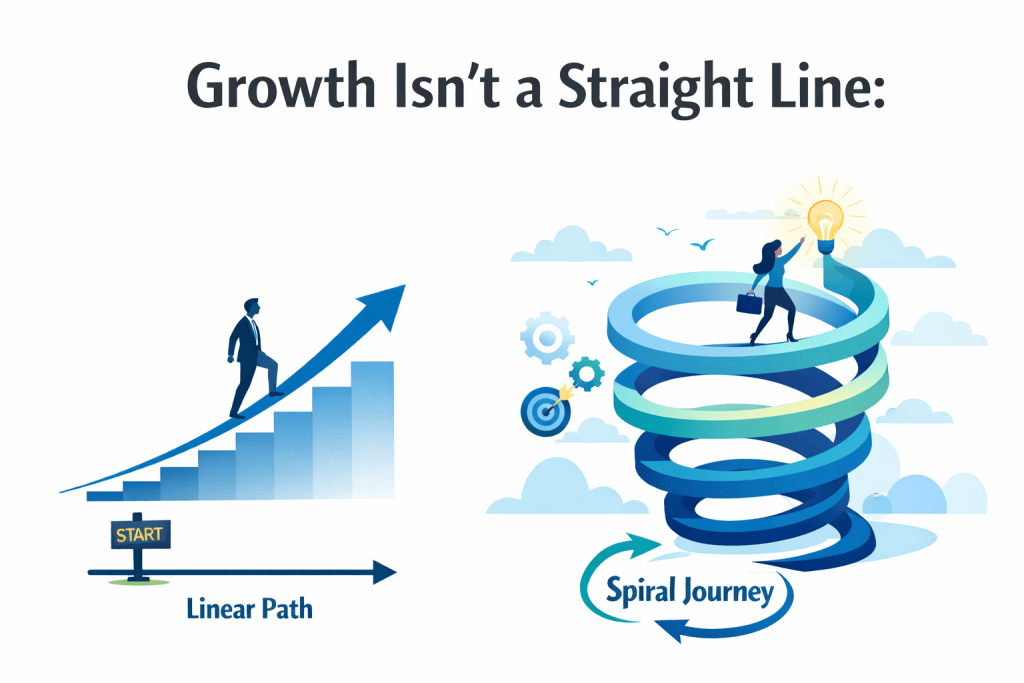
Why Human Development Moves in Spirals: Growth Isn’t a Straight Line

We often believe that human development is a straight, upward path, a neat progression where once we learn something, we move forward and leave the past behind. It is a comforting idea: growth as a checklist, maturity as a destination, and learning as something that happens once and is then complete. But real human development does not follow a straight line. It moves in a spiral. A spiral looks like repetition from a distance, but when you look closely, it is actually progression with depth. We return to the same themes, the same emotions, the same internal conflicts, but each time, we encounter them with a slightly more developed mind, a wider perspective, and a greater capacity to respond. What appears like “going in circles” is, in reality, growth unfolding layer by layer. Take emotional development as an example. A young child experiences anger in its most raw and physical form. As they grow, they begin to name it, understand triggers, and slowly learn regulation. But anger does not disappear with age. It reappears in adolescence, in relationships, in workplaces, sometimes unexpectedly. The difference is not that the emotion is gone, but that each time it returns, there is an opportunity to engage with it differently. This is the spiral at work: the same emotion, revisited at a higher level of awareness. This pattern continues throughout life. As adults, we often find ourselves facing familiar challenges, self-doubt before a big opportunity, insecurity in relationships, fear of failure when trying something new. It can feel frustrating, even discouraging, as though we are regressing or failing to “move on.” But this interpretation comes from a linear mindset. A spiral perspective invites a different understanding: we are not back at the beginning; we are revisiting the same point with more life behind us, more insight within us, and more choice in how we respond. This shift in perspective is particularly important in the way we approach parenting and education. When a child repeats a behavior, whether it is fear, anger, or hesitation, it is easy to assume that learning has not occurred. But development does not eliminate experiences; it reorganizes them. A child revisiting the same emotional pattern is not stuck; they are engaging with it at a new level of cognitive and emotional complexity. What they need is not correction for “not learning,” but support to navigate the next layer of understanding. Seeing development as spiral also changes how we relate to ourselves. It allows space for imperfection, for revisiting old wounds, for moments that feel like setbacks. Instead of asking, “Why am I here again?” we begin to ask, “What is different about how I can respond this time?” Growth then becomes less about escaping the past and more about integrating it. Human development, in its truest sense, is not about becoming someone entirely new. It is about becoming more deeply ourselves, through cycles of experience, reflection, and renewal. Each loop of the spiral carries traces of where we have been, while also expanding who we are becoming. And perhaps that is the quiet beauty of it: we are not moving away from our earlier selves, but continually returning to them, with more awareness, more compassion, and a little more wisdom each time. Leave feedback in comments section.

Why Human Development Moves in Spirals: Growth Isn’t a Straight Line Read More »

Emotional Well-being in Infants, Toddlers, and Young Children — A Parent’s Perspective

Author: Priyanka Gupta Kankane (IIM Lucknow, BITS Goa, Microsoft) Understanding emotional needs of young children Ages 0–6 monthsAt this stage, a child has very basic needs: food, sleep, freedom from pain or physical discomfort, and closeness to a caring and loving adult (biologically, often the mother). When these needs are consistently met, the child tends to thrive and progress healthily. What matters greatly at this stage is the emotional well-being and physical health of the primary caregiver, most often the mother. Postpartum depression (PPD), delivery-related challenges, or feeding difficulties can make the mother emotionally vulnerable, which may, in turn, affect the infant. A calm, supported, and emotionally secure mother helps the child feel safe and protected. Additionally, a peaceful and nurturing home environment contributes significantly to the infant’s sense of safety. Ages 6 months–2 yearsDuring this period, children begin to recognise familiar faces, toys, and environments. They also typically begin their transition to solid foods. Experiences such as prolonged crying (sometimes suggested in certain sleep-training approaches), exposure to shouting, loud noises, or darkness can create stress for young children and are best minimised. Beyond their primary needs, children now require playtime, connection with caregivers, and joyful interactions filled with laughter and engagement. At this stage, emotional development is still emerging, and children often mirror what they observe. Therefore, creating a warm, positive, and emotionally stable home environment is essential. Caregivers’ behaviour—being calm, playful, and responsive—plays a key role. Limiting exposure to conflict, distress, or negativity in the household supports the child’s emotional well-being. Ages 2–4 yearsAs toddlers transition into early childhood, they begin to enjoy social interactions with other children and engage more in activities outside the home, such as playgroups or play areas. Many children also start preschool or daycare, marking an important milestone in their emotional development. Although language skills develop rapidly, children at this stage are still learning to process and express their emotions. This often results in tantrums and emotional outbursts—commonly referred to as the “terrible twos” or “threes.” This is also a critical phase for developing emotional co-regulation. Children rely on caregivers to model how to manage strong emotions such as anger, frustration, sadness, and disappointment. They are keen observers and tend to imitate adult behaviour. If they witness shouting, aggression, or impulsive reactions, they may adopt similar patterns. Conversely, when they see adults pausing, taking deep breaths, expressing feelings verbally, or calming themselves in healthy ways, they learn that emotions can be managed safely. These lessons extend far beyond childhood and form the foundation of lifelong emotional health. It is equally important to set clear boundaries—for example, reinforcing that hitting or harming oneself is not acceptable—while encouraging safe emotional expression. Ages 4–6 yearsAs children grow more independent and spend increasing amounts of time at school, in play, and with peers, their emotional well-being begins to be influenced not only by caregivers but also by their social environment. Parents can support this stage by being aware of their child’s friendships, teachers, and broader social interactions. While children continue to learn emotional regulation from adults, they gradually become more predictable in their responses. If guided well, the frequency of intense tantrums and physical outbursts tends to decrease. Communication and reasoning improve significantly at this stage; however, children are still too young to manage strong emotions independently. The role of caregivers remains crucial in helping them understand, express, and regulate their feelings in healthy and constructive ways. If you would like to contribute to our newsletter, or join us as parent researcher or educator, please leave us a message, or write to priyanka.pointguard@gmail.com Follow Priyanka Agrawal on LinkedIn: http://www.linkedin.com/comm/mynetwork/discovery-see-all?usecase=PEOPLE_FOLLOWS&followMember=pagrawal1 Subscribe to Point Guard’s newsletter: https://www.linkedin.com/build-relation/newsletter-follow?entityUrn=7418911870050488320 Leave feedback in comments section.

Emotional Well-being in Infants, Toddlers, and Young Children — A Parent’s Perspective Read More »

Exposing Young Children to Indian Mythology and Spiritual Stories, and Their Impact

Author: Priyanka Gupta Kankane (IIM Lucknow, BITS Goa, Microsoft) Exposing Young Children to Indian Mythology and Spiritual Stories, and Their Impact “The earliest memories I have of watching content from my childhood are of watching Ramayan, Mahabharat, or Krishna on television while sitting with my grandparents, neighbours, and friends.”Does this sound relatable? The entire generation of the 1980s and 1990s—Gen Y, Millennials, and even parts of Gen Z—can still remember the music of these serials, their characters, the advertisement breaks on Doordarshan, and the excitement of waiting for the next episode on a calm Sunday morning. Over the past couple of decades, however, not only has media and content changed, but our exposure to these stories has gradually reduced. This reflection is not about religion or the worship of God. Rather, it is about stories—stories that shape generations, inspire us, and encourage deeper reflection on our own lives while imparting lessons about ethics, values, and dharma, regardless of the religion they originate from. These were stories not designed for ratings or consumerism, but rooted in philosophy, reflection, and humanity. Recently, I gifted a collection of stories from Amar Chitra Katha to a friend’s child. A few days later, the parent told me that the child had become completely absorbed in the stories, asking to hear them repeatedly and even attempting to role-play the characters at home. In a world filled with fast-paced digital entertainment like Cocomelon, this moment felt deeply meaningful for the parents. Their child was engaging with role models and stories that they themselves had grown up with—stories that were both relatable and inspiring. But why does storytelling matter so much in an age dominated by media and modern forms of content consumption? Stories serve as a bridge between generations, societies, and cultures. They nurture imagination in ways that few activities can match, and they provide children with opportunities to understand expression and communication through artistic traditions such as lok kathas, Panchatantra, Akbar–Birbal, Tenali Raman, and many others across different regions and languages. While many of these stories are now available through television serials and cartoons, one might ask: why focus on the written format? The answer is simple. Reading helps cultivate a love for books. It offers a screen-free experience with fewer distractions—just focused time, often spent with a parent or grandparent reading aloud to a young child. Another important aspect of storytelling is the development of listening, processing, imagining, and eventually applying lessons in real life. For example, values such as honesty, truthfulness, kindness, and healthy habits can often be conveyed more effectively through stories of wisdom than through direct instruction. At a time when children’s attention spans are increasingly challenged by screens, redirecting their attention to meaningful stories can be both beneficial and enriching. Stories also introduce children to native history and cultural traditions while being rooted in deep values and virtues. This exposure becomes especially important as many families today no longer live in joint family systems where such narratives would naturally emerge through conversations with grandparents. Stories can help recreate that connection to cultural roots and provide children with a sense of belonging—something the modern world often struggles to cultivate. Another perspective frequently shared by young urban parents is the challenge of raising children who are modern and confident while also remaining grounded in their cultural heritage. Mythological and spiritual stories often include a moral or learning element—shiksha or seekh—that encourages children to reflect on right and wrong and to internalise positive behaviours and habits. With these thoughts, let us open up a conversation:Which storybooks would you recommend to parents—across different age groups and languages—based on your personal experiences and reviews? If you would like to contribute to our newsletter, or join us as parent researcher or educator, please leave us a message, or write to priyanka.pointguard@gmail.com Follow Priyanka Agrawal on LinkedIn: http://www.linkedin.com/comm/mynetwork/discovery-see-all?usecase=PEOPLE_FOLLOWS&followMember=pagrawal1 Subscribe to Point Guard’s newsletter: https://www.linkedin.com/build-relation/newsletter-follow?entityUrn=7418911870050488320 Leave feedback in comments section.

Exposing Young Children to Indian Mythology and Spiritual Stories, and Their Impact Read More »

Scroll to Top