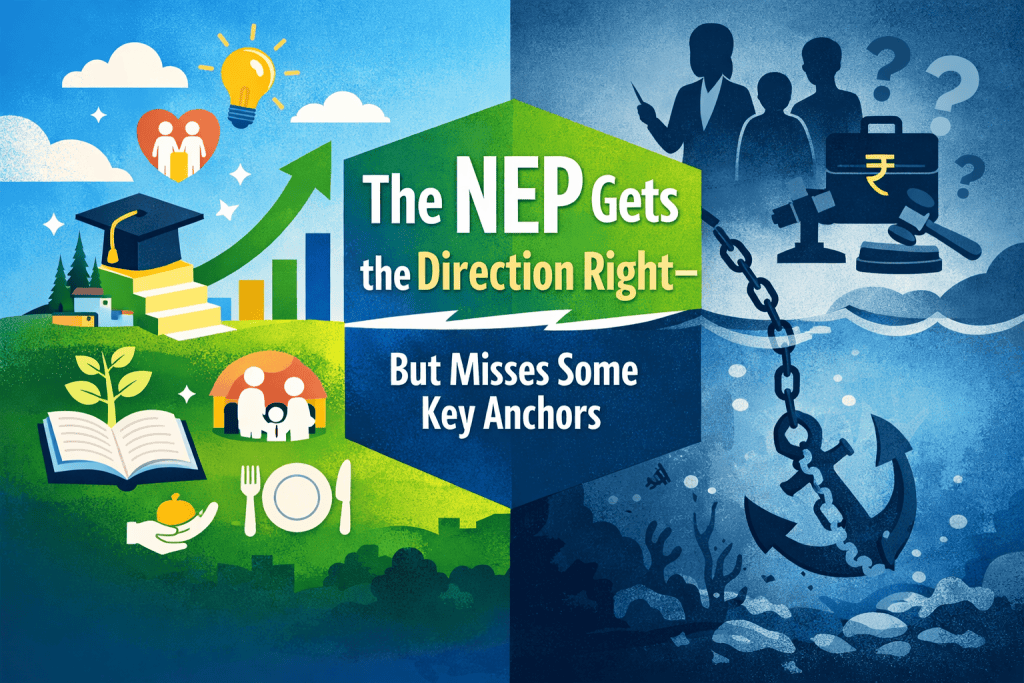
India’s National Education Policy (NEP) represents the most comprehensive rethink of education in decades. Its intent is progressive, research-backed, and necessary.
If you would like to contribute to our newsletter, or join us as parent researcher or educator, please leave us a message, or write to priyanka.pointguard@gmail.com
List of places parents can take their young children
India’s National Education Policy (NEP) represents the most comprehensive rethink of education in decades. Its intent is progressive, research-backed, and necessary.
Having attended Balvatika as a toddler and then moved to a CBSE English-medium school, I have experienced the very transitions the NEP now seeks to rationalise—care-based early learning, formal schooling, and outcome-driven education. From that lens, the policy deserves both appreciation and scrutiny.
What the NEP Gets Right
At its core, the NEP correctly expands the definition of education. It recognises that schooling must develop not only foundational and higher-order cognitive skills—literacy, numeracy, critical thinking, and problem-solving—but also social, ethical, and emotional capacities.
The emphasis on constitutional and human values—empathy, respect, democratic spirit, pluralism, scientific temper, equality, and justice—is timely. In an increasingly fragmented society, teaching children how to think ethically, not merely what to think, is essential.
The 5+3+3+4 structure and the inclusion of Early Childhood Care and Education (ECCE) from age three are among the policy’s strongest elements. Strengthening Anganwadis and focusing on foundational learning reflects global evidence: learning gaps formed early are the hardest to close later.
Equally important is the recognition that children cannot learn when they are hungry, unwell, or emotionally distressed. Integrating nutrition, mental health support, counsellors, social workers, and community participation reframes schools as care ecosystems rather than exam factories.
Assessment reform is another welcome shift. Redesigning Board exams to reduce rote learning, allow subject choice, enable multiple attempts, and test core competencies—rather than coaching endurance—addresses one of India’s most damaging educational distortions.
Finally, the move toward multidisciplinary education, even within elite technical institutions such as the IITs, signals an understanding that technical excellence without ethical and social grounding is incomplete.
Where the NEP Falls Short
Despite its breadth, the NEP underplays several forces that shape children’s daily realities.
First, while teachers are the centre-most and the strongest pillar of the education system, the policy needs to see this essential role with some humility because teachers are human, make mistakes, sometimes lethal, dangerous and harmful to children. Some guardrails are needed to ensure teachers’ own behaviour is appropriate.
Second, the absence of structured parental involvement is notable. Education does not operate in isolation from families. Values, emotional regulation, discipline, digital habits, and attitudes toward learning are shaped as much at home as at school. Without aligning parents and schools, children receive fragmented moral and behavioural cues.
Third, while constitutional values are emphasised, family values and everyday ethics—care, responsibility, boundaries, conflict resolution, and intergenerational respect—remain implicit rather than intentional. In a rapidly changing social fabric, these can no longer be assumed.
The policy also misses an opportunity to introduce basic legal and civic literacy. Understanding everyday rules and laws such as traffic rules, rights, duties, contracts, and digital responsibilities is essential for functional citizenship.
Finally, entrepreneurship and economic agency receive insufficient attention. In a country where formal employment cannot absorb all talent, children must be exposed early to problem-solving, value creation, financial literacy, and ethical enterprise.
A Necessary, But Incomplete, Reform
The NEP sets the right direction. It humanises education, broadens success beyond marks, and aligns India with global developmental thinking. To fully deliver on its promise, the NEP must look at family-school-community as its own system, practical life skills, and economic agency.
Meanwhile, let’s continue to follow and monitor existing policy implementation as a step forward.
If you would like to contribute to our newsletter, or join us as parent researcher or educator, please leave us a message, or write to priyanka.pointguard@gmail.com
Follow Priyanka Agrawal on LinkedIn: www.linkedin.com/comm/mynetwork/discovery-see-all?usecase=PEOPLE_FOLLOWS&followMember=pagrawal1
Subscribe to Point Guard’s newsletter: https://www.linkedin.com/build-relation/newsletter-follow?entityUrn=7418911870050488320
Leave feedback in comments section.